Open AI Beyond the Binary: Access, Capacity and Risk
-
Event
-
AI Governance
-
Multilateralism
As AI capabilities advance, the debate around open-source and open-weight models is becoming more consequential. Open approaches can support innovation and wider access, a potential recognized in the Global Digital Compact. More capable systems, however, also raise increasingly important questions about safety, security, and accountability.
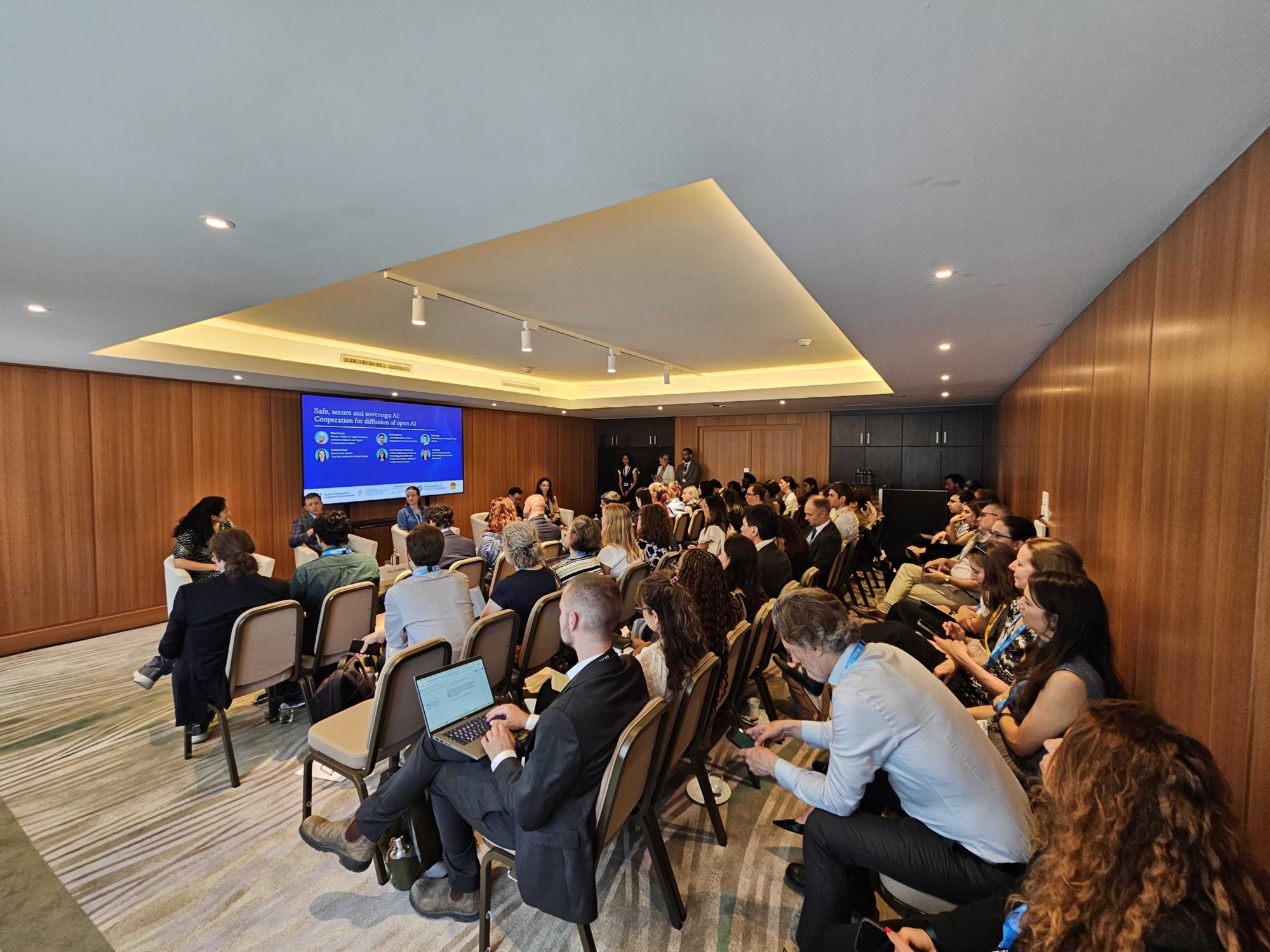
On the sidelines of the inaugural UN Global Dialogue on AI Governance, the Simon Institute (SI) co-convened a session entitled “Safe, secure, and sovereign AI: cooperation for the diffusion of open AI.” The session focused on themes such as meaningful access, technological capacity building, and shared approaches and mechanisms for safety and security.
Three themes stood out from the discussion.
1. Meaningful access requires more than open models
Opening the discussion, Niamh Smyth, Ireland’s Minister of State for Trade Promotion, Artificial Intelligence & Digital Transformation, framed the challenge as one of balancing the potential benefits of openness with evolving safety and security risks. She stressed that safeguards will need to keep pace with advances in AI capabilities.
A recurring point was the need for greater precision about what access means in practice. Mark Latonero, Chief Global Affairs Officer at the Responsible AI Future Foundation, cautioned against assuming that an open model is automatically accessible. While open models may allow access to model weights, enable greater problem-fixing ability, and be relatively inexpensive to use, harnessing them effectively still requires some amount of compute, electricity, and technical expertise. From this perspective, downloading and running an open-weight model locally may be less accessible than accessing AI in your standard search browser.
Latonero pointed to AI Singapore’s SEA-LION model series as an encouraging example of how open models can be tailored to languages and contexts that are often underserved by globally dominant systems. SEA-LION builds upon open models from Google, Alibaba, and others to optimize for Southeast Asian language performance.
Felix Reda, Senior Director of Developer Policy, GitHub, added that meaningful local adaptation also depends on suitable data. General multilingual data may not be sufficient to develop systems that perform well in specialized domains. Researchers also face practical and legal challenges in assembling and sharing the specialized datasets needed to improve multilingual models.
The discussion also considered how governments are using open technologies in practice. Elizabeth Seger, Senior Policy Advisor at the Tony Blair Institute for Global Change, pointed to India, where recent work on multilingual large language models builds on a much longer tradition of open-source adoption.
Since 2015, Indian government policy has required federal ministries to prioritise open-source software, while the IndiaAI programme is now providing compute resources to developers and researchers. Seger argued that this wider enabling environment helps explain why India has been able to make notable progress on locally relevant AI, including models designed to work across 36 regional languages and dialects.
The contributions underscored that model availability alone does not guarantee meaningful access. The benefits of openness also depend on access to data, infrastructure, and expertise, and on government capacity to design and deploy systems for public benefit.
2. Sovereignty can be enhanced through open models, but requires strategic choices
The discussion also explored the link between open approaches and AI sovereignty. Adopting open models rather than procuring them from overseas commercial providers allows data to be stored and processed in-country and reduces foreign dependencies.
Luiza Valladares de Gouvêa, an Advisor in the Department of Science, Technology, Innovation, and Intellectual Property at Brazil’s Ministry of Foreign Affairs, described Brazil’s efforts to strengthen domestic AI capacity through its national AI plan, which foresees R$23 billion in investment through 2028 and includes the development of Portuguese-language models based on national data.
She also stressed the importance of sovereign data infrastructure, highlighting efforts to use Brazil’s renewable energy capacity to attract data centre investment while seeking wider benefits for domestic research and development. This reinforced a broader theme in the discussion: while complete technological independence may be unrealistic, countries can be strategic about what they build domestically and what they seek in return from external partnerships.
The discussion suggested that sovereignty should not be equated with complete technological independence. As Elizabeth Seger noted, countries need to make strategic choices about the capabilities they build domestically and the dependencies they accept. In parts of Africa, for example, governments are exploring partnerships with hyperscalers that could support not only data centre development but also the surrounding energy infrastructure.
As Latonero observed, efforts to strengthen national or regional AI capacity may therefore increase, rather than reduce, the importance of international cooperation. The challenge is to build external partnerships in ways that strengthen domestic capacity over the longer term.
3. Safety and security require action across the ecosystem
Rather than treating openness as a binary policy choice, the discussion focused on what is needed to mitigate risk while preserving opportunities for innovation, adaptation, and wider participation.
Seger argued that responsibility cannot rest with model developers alone. Once models are distributed, they can be copied, modified, hosted, and deployed by different actors, making access restrictions at certain capability thresholds difficult to enforce fully. Drawing on parallels with online safety, she emphasised the need for safeguards across the wider ecosystem, including developers, hosting platforms, and governments, alongside greater investment in societal resilience. This also requires building capacity within public institutions so that governments can assess how open models can be deployed responsibly and when additional security measures may be needed.
Reda built on this point about societal resilience, citing concerns that AI models could enable cyberattacks. He argued that greater investment is needed to maintain and secure the software and digital infrastructure that attackers may target. In Reda’s view, restricting access to models cannot substitute for addressing ecosystem vulnerabilities and raises questions about who has the legitimacy to control access to powerful systems.
Valladares de Gouvêa highlighted the role of government regulation in managing risk. She described how Brazil’s developing regulatory framework determines requirements according to the level and nature of risk (with obligations for systemic-risk General purpose AI models applying regardless of whether the system is supplied under open-source licenses).
The discussion also considered how cooperation could support more effective governance. Latonero highlighted the convening role of multilateral institutions while making the case for regional hubs that could help neighboring countries exchange practical experience and share lessons with other international policy stakeholders.
Moving beyond the open-versus-closed debate
Across the session, the emphasis was on moving from broad debates about openness towards more specific governance questions: what forms of access are needed, what capacities are required to benefit from them, which dependencies matter most, and how responsibility for safety and security should be shared.
Ahead of the next UN Global Dialogue in New York in May 2027, the discussion pointed to the need to move beyond a binary open-versus-closed debate. The risk profiles of open models vary considerably depending on their size, capabilities, and the safeguards in place. A more nuanced approach is therefore needed to weigh benefits and risks, alongside a clearer understanding of how responsibility for safety is distributed across the wider AI ecosystem.
With thanks to our co-organizers: the Department of Enterprise, Tourism and Employment of Ireland, the Ministry of Foreign Affairs of Brazil, the Responsible AI Future Foundation, and the Minderoo Foundation.