Translating Scientific Evidence into Action: Emerging Priorities for AI Governance
-
Event
-
AI Governance
-
Multilateralism
On Monday, 6 July 2026, experts and representatives from governments, companies, research institutions, civil society, and international organizations gathered in Geneva for the first UN Global Dialogue on AI Governance. Following the opening ceremony, the day began with the Plenary presentation of the preliminary report of the multidisciplinary Independent International Scientific Panel on Artificial Intelligence. The question of how to translate evidence and scientific findings into tangible, real-world, collaborative action remained a recurring theme throughout the day’s discussions.
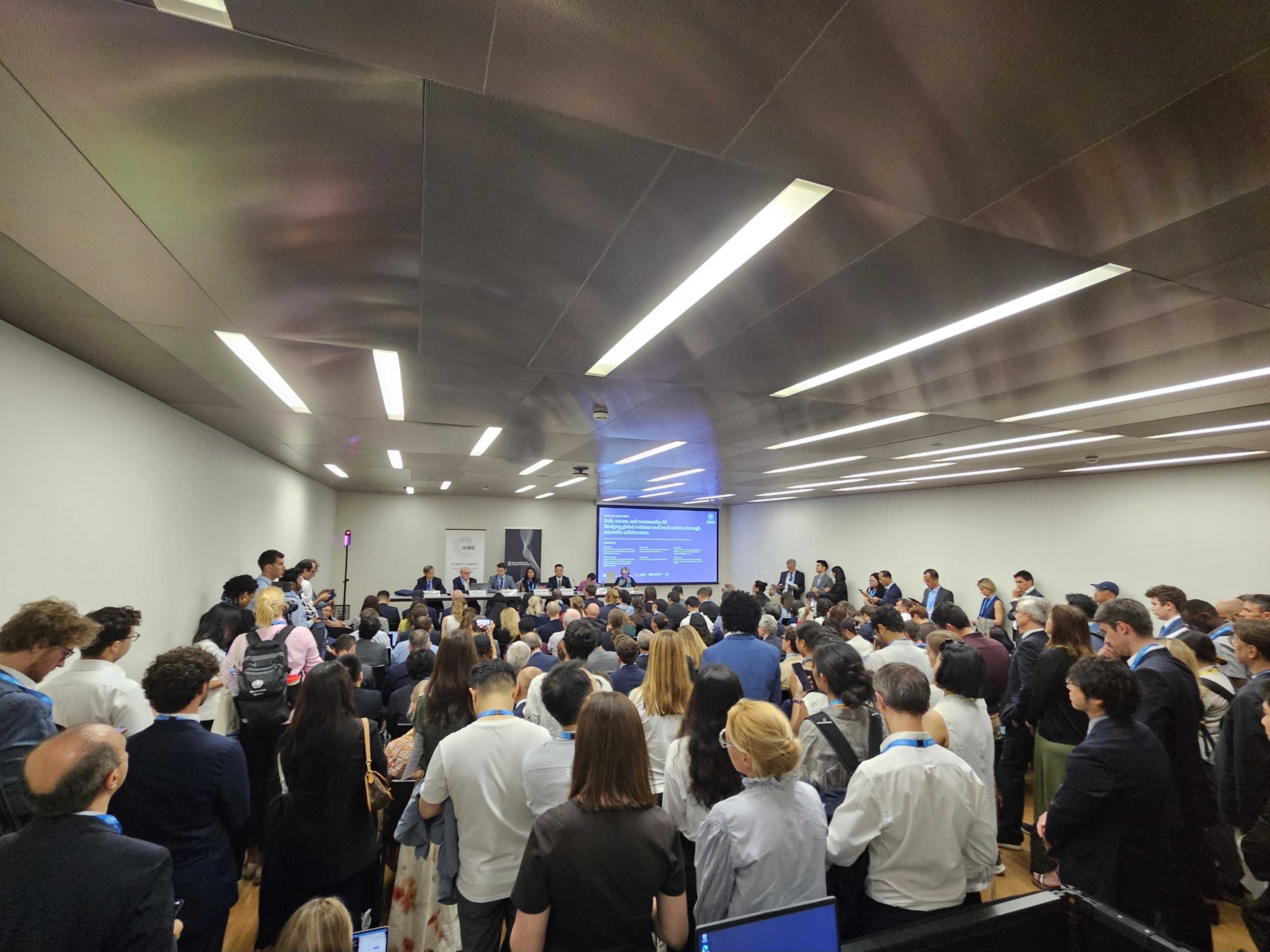
This question was at the centre of the official side event entitled ‘Safe, secure, and trustworthy AI: Bridging global evidence and local realities through scientific collaboration’ (6 July 2026), co-convened by the Simon Institute for Longterm Governance (SI) and Tsinghua University. The event brought together representatives from governments, civil society, and academia, including members of the UN Independent International Scientific Panel on AI and contributors to the International AI Safety Report 2026 and the forthcoming Global South AI Safety Report. The purpose of the discussion was to present a state-of-the-science assessment identifying areas of consensus and, consequently, clearer solutions to ensure that AI governance can keep pace with global risks.
In the opening remarks, H.E. Ambassador Philip Thigo, Special Envoy on Technology, Republic of Kenya, framed the discussion around the idea of shared capacity; no single actor possesses all the knowledge required to govern AI, and that knowledge must be developed collectively and continuously. H.E. Ambassador Shen Jian, Ambassador for Disarmament Affairs of China and Deputy Permanent Representative to the United Nations Office at Geneva, similarly highlighted the dual challenge facing many developing countries: not only expanding digital infrastructure and AI access, but also strengthening their ability to participate meaningfully in international AI governance processes.
Two rounds of panel discussion followed, examining emerging AI safety challenges and the relationship between scientific research, industry, and policymaking, respectively. The session concluded with a discussion on priorities ahead of the next Global Dialogue, set to take place in May 2027, in New York.
Below are SI’s reflections on some of the key themes and takeaways:
1. Scientific understanding of AI risks is advancing faster than agreement on how to manage them
Speakers agreed that scientific understanding of and agreement on AI-related risks have progressed considerably in recent years. UC Berkeley’s Prof. Stuart Russell, Senior Adviser to the International AI Safety Report 2026, observed that concerns relating to disinformation, cybersecurity, biological risks, and loss of control increasingly appear across scientific assessments and international discussions. He also pointed to a growing concern about the potential erosion of human purpose through excessive reliance on AI systems.
Stephen Clare, lead writer of the same report, introduced the report’s framework of misuse, malfunctions, and management as a useful way of organising this emerging scientific consensus, while noting that important disagreements remain over the likelihood, severity, and timing of individual risks. Both he and Russell emphasized that debate has increasingly shifted away from whether these risks exist towards how societies should respond to them.
That shift places governance at the centre of international discussions. Russell argued for defining a “safe envelope” for AI development through behavioural red lines that advanced systems should never cross. Russell drew comparisons with long-established regulatory approaches in sectors such as aviation, construction, and food safety, where regulation has supported rather than prevented innovation.
Maria Ressa, co-chair of the UN Independent International Scientific Panel on AI, argued that the opportunity to establish effective governance frameworks may narrow over time as AI capabilities continue to advance. Ressa stressed the urgency of this call to collectively steer towards good futures.
2. Building AI safety requires collaboration across science, industry, and diverse communities
A recurring theme throughout the discussion was that AI safety cannot be understood solely as an objective, technical property of AI models.
Urvashi Aneja, Co-chair of the Global South Network on Trustworthy AI and Founding Director of Digital Futures Lab, argued that what counts as tolerable or intolerable risk is subjective. Safety also depends on the context in which AI systems are deployed, including the regulatory capacity of the countries where deployment happens. She questioned whose safety current governance discussions are prioritising, pointing to neglected issues affecting data annotators and children involved in extracting critical minerals used in AI hardware. Aneja also highlighted an important evidence gap. Research examining AI’s societal impacts remains concentrated in a relatively small number of countries, leaving many regions underrepresented in the available evidence base. This creates challenges for designing governance approaches that genuinely reflect diverse social and economic contexts.
The discussion also highlighted capacity constraints within the scientific community itself. As noted by Song Haitao, President of the Shanghai Artificial Intelligence Research Institute and Member of the UN Scientific Panel, researchers often lack important ingredients for accurate risk assessment: sufficient access to frontier AI systems, computational resources, and up-to-date information about state-of-the-art model training practices. Song argued that stronger collaboration between scientists and industry is therefore essential, and something that can help scientists amplify their real-world impact.
In a similar vein, Prof. Xue Lan, Distinguished Professor and Dean of Tsinghua University’s Institute for AI International Governance (I-AIIG), addressed how scientific collaboration can be sustained amid today’s geopolitical realities. He called for upholding the principle of open scientific collaboration and proposed defining “safe zones” for international collaboration in areas outside sensitive dual-use research. Philanthropic and other non-governmental funders may be better placed than national governments to support such international research collaborations. Finally, he encouraged the international community to identify shared global challenges that require scientific cooperation across borders.
3. International scientific collaboration as a foundation for impact-focused, interoperable AI governance
The closing discussion focused on practical steps that could be advanced before the next Global Dialogue in May 2027.
Maria Ressa argued that protecting information integrity should be prioritized as a prerequisite for effective AI governance and called for greater investment in publicly available safety infrastructure. As one example, she referenced Roost, an open-source safety tooling initiative, as an illustration of collaborative approaches to improving AI safety.
Stuart Russell proposed establishing a dedicated secretariat and legal support for the Global Dialogue, noting that many current contributors to governance discussions and scientific assessments participate alongside full-time professional responsibilities. He also proposed that governments should establish a legal right for individuals to know whether they are interacting with another person or an AI system.
Urvashi Aneja called for more open evaluation infrastructure that would enable local communities, not only technical experts, to participate in shaping how AI systems are assessed within their own contexts. AI governance needs to be more inclusive and tailored to local realities.
Prof. Xue Lan emphasized that governments have a key role to play in supporting AI safety research. Like climate change, he noted, AI safety is a global challenge that no single country can tackle alone and that calls for a collective response from all of humanity. He therefore called for closer collaboration among national AI safety research institutions to strengthen scientific cooperation and help ensure that AI safety standards are effectively implemented.
Taken together, these proposals suggest that future progress in AI governance may depend not only on developing new regulatory frameworks but also on investing in the infrastructure and institutional capacity needed to support them.
This event was organized in collaboration with: The Simon Institute for Longterm Governance, Tsinghua University AIIG, The International Association for Safe and Ethical AI (IASEAI), AI Safety Connect (AISC), Office of the Envoy on Technology, Kenya, and, Global South Network on Trustworthy AI, University of Geneva, University of Zurich, Globalethics, World Federation of Engineering Organizations – Engineering Capacity Building for Africa, Programme (WFEO ECBAP), International AI Governance Association, UNU Hub for Promoting Ethical and Responsible Artificial Intelligence Development, UNU AI Network, Natural, Artificial and Organisational Intelligence Institute, University of Auckland, China Internet Governance Forum, CAST UN Consultative Committee on Science Diplomacy, Colégio Brasileiro de Altos Estudos, Federal University of Rio de Janeiro, Minderoo Foundation, and the UN Foundation.