
Open AI Models: An Introduction
-
Explainer
-
AI Governance
Open-source and open-weight AI are receiving significant attention from policymakers. The development of open AI models (along with open-source software and open data) will be one of seven priority topics for the first UN Global Dialogue on AI Governance in July 2026.1 Open AI models are also promoted in national and regional policies, including China’s AI Plus initiative, the EU’s Apply AI Strategy, and more recently the US AI Action Plan. Growing policy attention has come alongside a narrowing of the performance gap between open-weight and closed-weight models, according to multiple benchmarks.2
This article is the first in a series on open AI development, why it matters, and where it is headed. After clarifying core concepts, this article examines the policy and commercial drivers for open model promotion as well as safety and governance considerations.
What does openness in AI development mean?
AI systems exist on a spectrum of openness depending on how many of their components (e.g., training and inference code, model architecture, training data, model weights) are publicly available and to what degree of accessibility.3
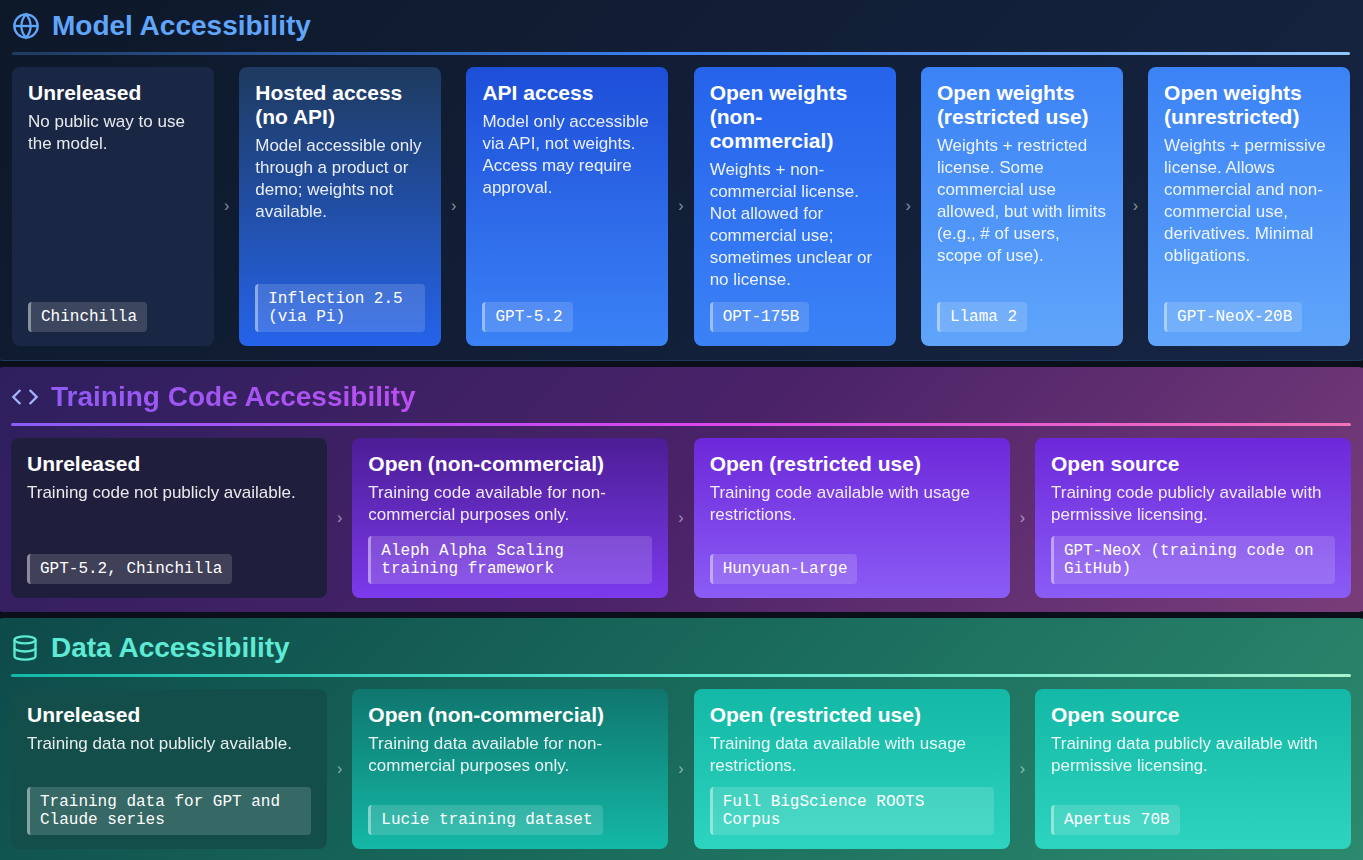
Spectrums of accessibility for models, training code and training data. Adapted from Appendix A, How behind are open models? | Epoch AI, with examples of training code and datasets added by the author.
Definitions and classifications are contested. “Open-weight” can refer to models whose weights are freely available for unrestricted download and use, or those whose weights are downloadable only for certain purposes or for a maximum number of end-users (see right-hand side of top row in infographic above). The definition of open-source AI, according to the Open Source Initiative’s v1.0 proposal endorsed by organizations including Mozilla and EleutherAI, is more demanding. It requires the accessibility of parameters (or weights), code and data information (“sufficiently detailed information about the data used to train the system so that a skilled person can build a substantially equivalent system”). As very few competitive AI models today meet this definition, “open (AI) models” in this series denotes open-weight models.
The further along a system is on the openness spectrum, the greater the ease with which others can use, study, modify, and share it. This may be good or bad depending on the purpose the deploying party uses it for. However, even highly open models face practical constraints on downloads and usage, particularly compute requirements and technical know-how. The most widely downloaded models on Hugging Face—the largest public repository of AI models and datasets—tend to be smaller models that can be run on laptops or a single consumer GPU rather than multi-GPU clusters. For users with limited technical capacity, accessing models via intuitive web interfaces—or, for higher-volume or more customized use, through application programming interfaces (APIs)—remains more practical than deploying open-weight models locally. Cloud service providers play an important enabling role for developers and IT teams by offering hosted access to open-weight models, along with tools to streamline fine-tuning and deployment.
Policy Drivers
Several policy considerations are increasing demand for and interest in open models.
First, open models are perceived as conducive to AI development and diffusion due to their cost and accessibility advantages over proprietary alternatives. Companies and governments (including the providers of digital public infrastructure such as identity or payment platforms) can deploy models without recurring licensing or API fees, making experimentation and scaling more feasible. In addition, developers can rapidly build models with new or improved capabilities by fine-tuning open models on task-specific data or through distillation, in which a smaller model is trained on outputs generated by a larger model to inherit the latter’s capabilities.4 For these reasons, a partner at American venture-capital firm Andreessen Horowitz estimates that 80% of entrepreneurs pitching the firm are using a Chinese open model.
Second, sovereignty concerns make open options appealing. The ability to do further pre-training or fine-tuning of open models facilitates adaptation to local languages, norms, and needs. For instance, the SEA-LION model series builds upon open models from Google, Alibaba and others to optimize for Southeast Asian language performance. Furthermore, adopting open models rather than licensing them from overseas commercial providers allows data to be stored and processed in-country and reduces foreign dependencies. Achieving these benefits depends on local talent, data and compute infrastructure; open models alone are not a silver bullet.
Third, there are benefits for transparency and trust. Model weights are essential for several strands of research across AI security and safety, including white-box robustness testing and mechanistic interpretability, both of which rely on direct access to internal model structure.
In addition, norms of participatory, multistakeholder, and transparent governance prevalent in earlier discussions about Internet and data governance continue to influence expectations around AI, increasing demand for open approaches.
Commercial Drivers
Beyond the factors outlined above, several other perceived benefits are driving commercial demand for open AI models from both public and private customers:
- Avoiding vendor lock-In: Organizations gain freedom from restrictive vendor relationships and future-proofing against sudden discontinuation or price hikes by model providers. This can be especially valuable for organizations with high-volume usage or start-ups still in an experimental phase.
- Customizability: Models can be adapted for specific industry needs and fine-tuned on proprietary or sensitive datasets, providing competitive differentiation and greater accuracy in specialized tasks.
- Data security and privacy: Models can be run on private infrastructure, ensuring full control over commercially sensitive data and compliance with sector-specific regulations—often important for fields like healthcare, finance, and public services.
- Reduced latency: Open models facilitate on-premises or on-device deployment, minimizing delays and increasing suitability for time-sensitive applications such as industrial automation and Internet of Things.
On the supply side, why would developers make their model weights (and other artifacts) open, especially those who are training large foundation models at huge cost?5 Reasons include:
- Monetization through complementary services: Even when the core model is open, model developers can monetize through charging for custom fine-tuning, API hosting, or support services. Developers who also provide cloud services, such as Google, Alibaba, and Microsoft, can benefit from their open-source models increasing demand for AI inference.
- Brand recognition and ecosystem influence: Open models have the potential for widespread adoption and strengthening the developer’s perceived technological leadership, which also has benefits for talent recruitment.
- Competitive pressures: The popularity of other companies’ open models and the downward pressure on prices they have caused appear to have prompted more firms to launch or expand open offerings, at least in China.
- Accelerated innovation from community collaboration: By releasing model weights openly, developers tap into global expertise, benefiting from rapid optimization and creative modification from others.
Safety and Governance Considerations
At the same time that political and economic incentives are encouraging global diffusion of open models, those models are becoming increasingly capable. Research by Epoch has found that the capabilities of open-weight models trail those of closed models by about 3 to 12 months. This means their diffusion has significant potential implications for safety and governance.
On the one hand, the greater accessibility of open models to researchers can bring benefits for identifying and addressing safety vulnerabilities. On the other hand, recognition of the risks from openly releasing leading models has grown as their capabilities have improved and awareness of the difficulties of monitoring and restricting open model use has increased. Progress in consumer hardware now allows anyone to locally run open-weight models that were at the frontier of LLM performance just 6 to 12 months ago. Whereas API-based deployment allows developers to moderate content and take action against accounts that repeatedly violate usage policies, developers lose all control once users download open-weight models locally. Research has shown that the effects of safety fine-tuning can be removed from open-weight models. This could make it easier for groups or individuals to misuse them for malicious purposes, such as hacking critical infrastructure or facilitating bioweapons research.
Looking Ahead
If recent trends continue, we expect increased global demand for solutions that maximise the economic and societal benefits of openness in AI while minimising the growing risks. The next part in this series will provide an overview of the positions of leading AI developers and states regarding open AI and explore emerging areas for international policy discussion and research.
- This builds on the recognition in the Global Digital Compact of open-source software, open data, and open AI models as digital public goods and key drivers of inclusive digital transformation and innovation.
- Including Chatbot Arena Leaderboard, MMLU, MATH, and HumanEval. See pp.95-96, “The AI Index 2025 Annual Report,” AI Index Steering Committee, Institute for Human-Centered AI, Stanford University, Stanford, CA, April 2025.
- The model weights (the numbers that get iteratively updated during training to specify how inputs get transformed into output) are arguably the most important component.
- Many closed-source model providers have terms of service that prevent use of model outputs to fine-tune or distil another model.
- Even DeepSeek, the Chinese open-weight model developer renowned for compute-efficient innovation, is estimated to have spent well over $500M on hardware throughout its history.