
Putting a Floor on the Global Consensus on AI
-
Commentary
-
AI Governance
-
Multilateralism
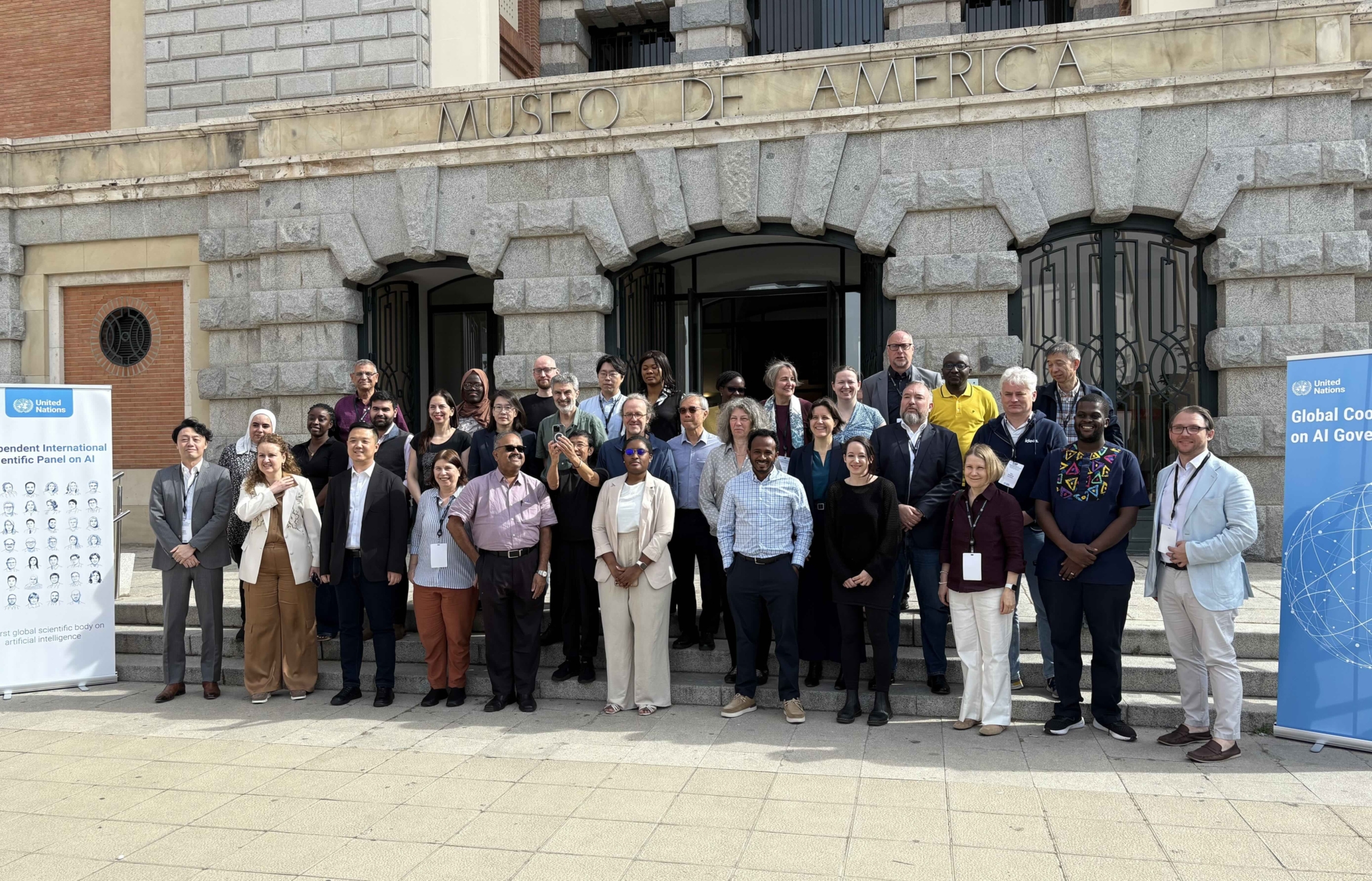
On 1 July 2026, the UN’s Independent International Scientific Panel on AI published its preliminary assessment of opportunities, risks, and impacts of AI. The Panel brings together a highly diverse group of 40 experts from 37 countries, and has developed this first joint summary in a period of a bit more than a month between April and May 2026. This week it will be presented to policymakers at the first Global Dialogue on AI Governance.
This first report of the Panel is the result of a long arc of incremental institutional progress starting from early ideation, to the High-Level Advisory Body on AI, to the Global Digital Compact, to the negotiation of the Panel & Dialogue mandate. But hopefully this is just the end of the beginning for the Panel. The first kilometer of a marathon.
The Panel’s report is designated as a preliminary assessment due to time constraints. The first full global assessment for the next Global Dialogue in May 2027 should involve more external experts with more layers of peer review. This first intermediary report provides scene-setting and represents a floor on the global scientific consensus. At a minimum, it shows that there is common epistemic ground within this diverse group of 40 AI experts on a number of topics.
Selected areas of consensus
While I would encourage you to read the full report (and the accompanying message from the co-chairs), three cross-cutting and noteworthy topics emerge in the report:
1. Pace: AI capabilities are advancing faster than the ability to measure or govern them.
The Panel finds that capability improvements have not slowed down and are potentially accelerating. Our tools to assess AI are at risk of falling behind: benchmarks saturate, models increasingly recognize when they are being evaluated, and documented cases of AI deception undermine the validity of safety testing.
The Panel does not make any policy recommendations. However, the policy relevance is clear:
Countries that have not invested in AI assessment capacity yet should consider doing so. More broadly, there is a question of what legal frameworks support an AI testing ecosystem that can keep up with the technology..
For example, at a national level, AI testing could happen through licensed private AI audit organizations or through public “FDA-style” bodies. At an international level, this brings us back to the question of what should be tested locally, and where regulatory reliance on another national or international body is sufficient or even desired to maintain interoperability.
2. Power: High concentration and the fear of being left behind
In 2025, 75% of the computing power of the 500 largest known AI clusters was located in the United States, and institutions in the US and China produced 94 notable AI models against 13 in the rest of the world. This concentration of power can be self-reinforcing as frontier AI is increasingly used to develop the next generation of AI.
The panel does not prescribe a solution to this concentration issue. Yet, it does highlight the need for investment across different geographies and the sovereignty advantages of open-weight AI models. As highlighted before, the responsible diffusion of open AI is important to manage the twin challenges of power concentration and serious misuse risk. In some cases, pooled resources to develop datasets, AI models, and AI applications may be part of the solution. Neither of these approaches require every country to build its own end-to-end AI stack.
3. Control: Oversight for agentic AI needs to be operationalized.
Agentic AI can browse the web, use software tools, make decisions, execute code, manage and work with other agents, and operate computers with increasing autonomy. Human oversight exists as a legal requirement, but it is not yet operationalized for AI agents as a measurable requirement.
Again, the panel does not make any recommendations. The most policy-relevant aspects of this challenge are red lines and standards. Some may want to discuss red lines on the types of autonomy that we want to avoid. Others may want to operationalize human oversight as a substantive requirement through standards for a variety of aspects, from agent identifiers to real-time monitoring by deployers, to activity logs for post-hoc analysis.
The Panel’s mission ahead
The Panel has indicated some of its next steps in the preliminary report. The following are my own thoughts:
1. Preserving complementarity
There won’t be a “Panel B” at the UN level. At the same time, the UN does not have an epistemic monopoly. For example, I’m also excited about the work of EpochAI, METR, Apollo, and the International AI Safety Report in summarizing the state-of-AI and its trajectory. Indeed, their work will often be faster and more detailed than that of a UN scientific panel. To some degree, this reflects a difference of function and an adequate division of labor.
The role of the UN Panel is to be a science-policy interface. It is easy to forget, but the value of the first IPCC report was not that it was more detailed than previous climate science. It took the IPCC seven years from its founding to conclude in 1995 that there was a “discernible human influence” on the climate, and until 2021 to call it “unequivocal.” Consensus-building across a wide range of stakeholders can be slow, but it is what turns scientific findings into a shared epistemic basis, including for any potential international negotiation, should there be political will for it at some point in the future. Building a consensus at the level of universality and legitimacy that the UN offers is what confers this UN Panel its unique function. Therefore, the UN Panel and more specialized efforts like the International AI Safety Report have overlapping but different mandates, and, for now, I would not recommend merging them.
2. Producing thematic briefs as needed
The Panel has the mandate to produce thematic briefs at any time, as needed. Using this shorter, more thematically focused format is important to remain agile and policy relevant. It is also up to Member States and other stakeholders to let the Panel know which aspects they would like to receive additional evidence on. Personally, I would highlight that a forward-looking if-then scenario analysis is an established way to advance preparedness under uncertainty. This form of foresight is established practice in other scientific panels like the IPCC that work with reference scenarios, and similar to how the AI industry itself deals with uncertainty through if-then commitments in Responsible Scaling Policies.
3. The first assessment leveraging external experts and peer review by May 2027
The preliminary report was shaped by the need to self-organize in a short period of time. For the full report in May 2027, the panel has the time to agree on and execute a more comprehensive process. The 40 Panel members have to be the final review layer, but they do not have to put on themselves the near impossible burden of drafting every aspect of a more comprehensive review. The way most scientific panels have managed this complexity is by the Panel members controlling the outline of the report and reviewing the report to ensure consistency and evidence quality. However, the Panel has the explicit freedom to tap as many external experts as needed for drafting specific sections on which they have expertise and/or helping to review sections drafted by others.
The persistent need for human sensemaking
Humans seem poised to co-exist with an exponentially increasing number of AIs that will be increasingly superhuman in many ways. The path ahead, the long and winding climb up “the foothills of the singularity”, looks daunting – steep, uncharted, covered in mist. In the vast majority of non-dystopic futures, we will still have collective action problems, and we will still need collective sensemaking on AI in 10 years, 50 years, and 100 years. While future scientific panels will likely leverage AI in many ways, it is arguably part of human agency that we will still want a layer of human experts to review the landscape of AI risks, opportunities, and impacts as they best understand them and share that with other humans. Cultural learning is the human superpower. It would be cognitive surrender to give up on that.
All of this to say: I’m rooting for the Independent International Scientific Panel on AI to become a successful, long-term institution, and I hope you do too.
* The author has been contracted by the UN University as editing & drafting support for the Independent International Scientific Panel. However, this blog neither reflects the opinion of UN University nor of the Independent International Scientific Panel. It is the personal commentary of the author written in his function as Senior Tech Policy Specialist at the Simon Institute covering AI governance in the multilateral system. The author confirms that this publication is based on publicly available information and that no confidential or non-public information obtained through work undertaken for UN University and the Independent International Scientific Panel has been used or disclosed for it.